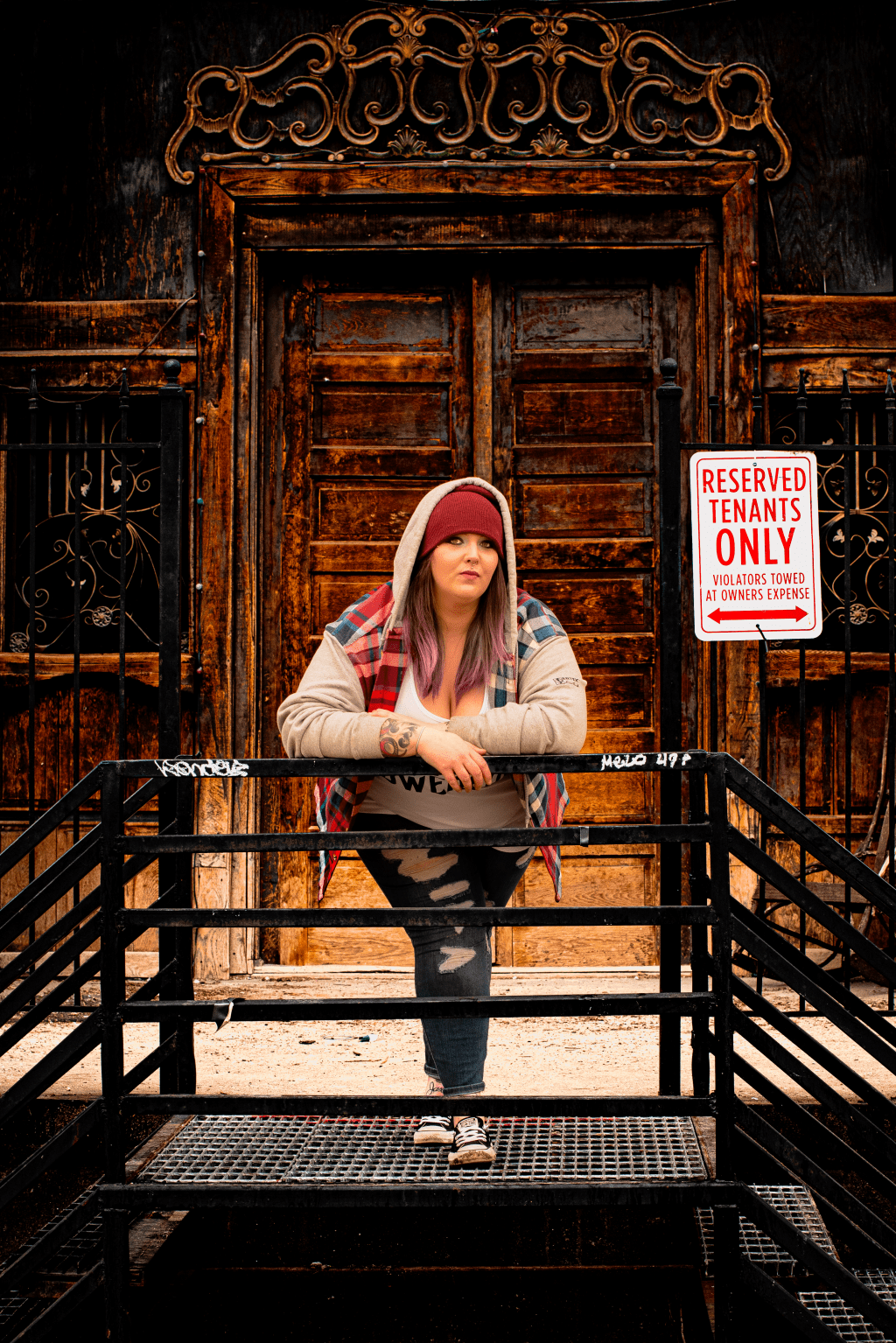
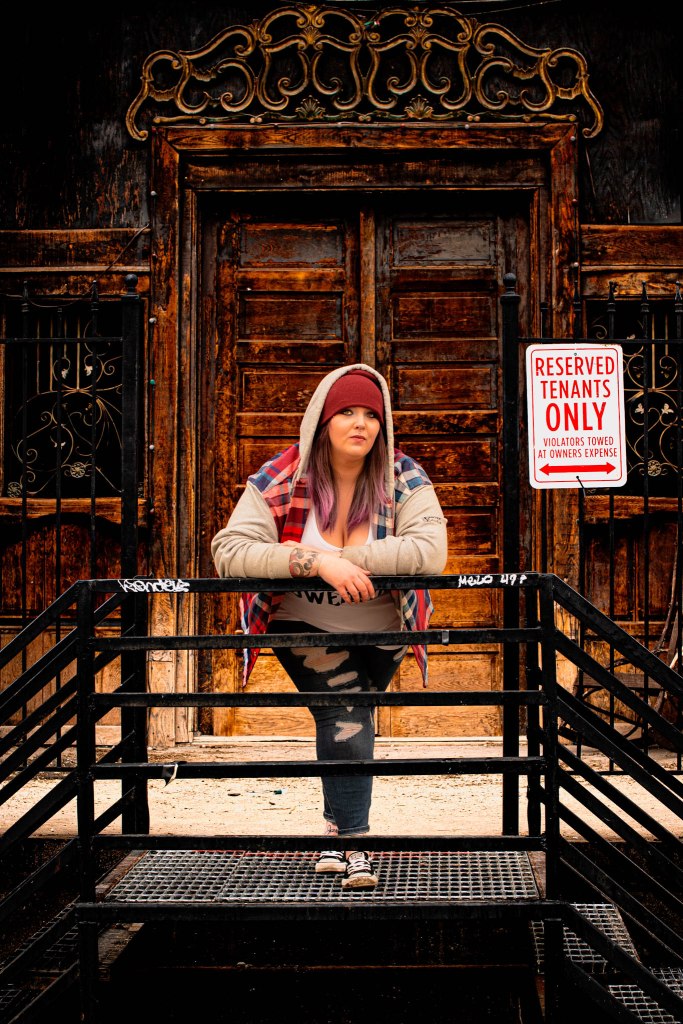
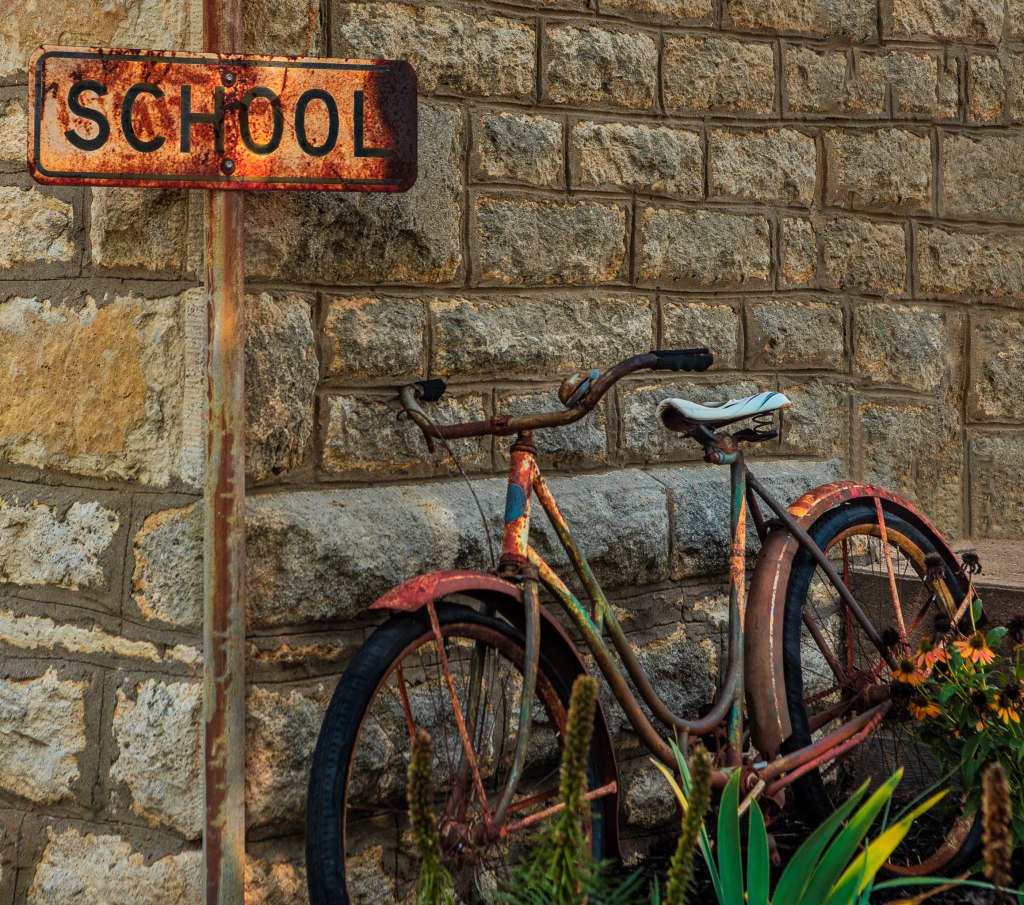
I know I beat this topic to death, but I’m going to say it again. The ability to post-process and “alter reality” is sometimes necessary for the creation of art. Take a look at the image above. it has been altered and an element removed! Aghast!
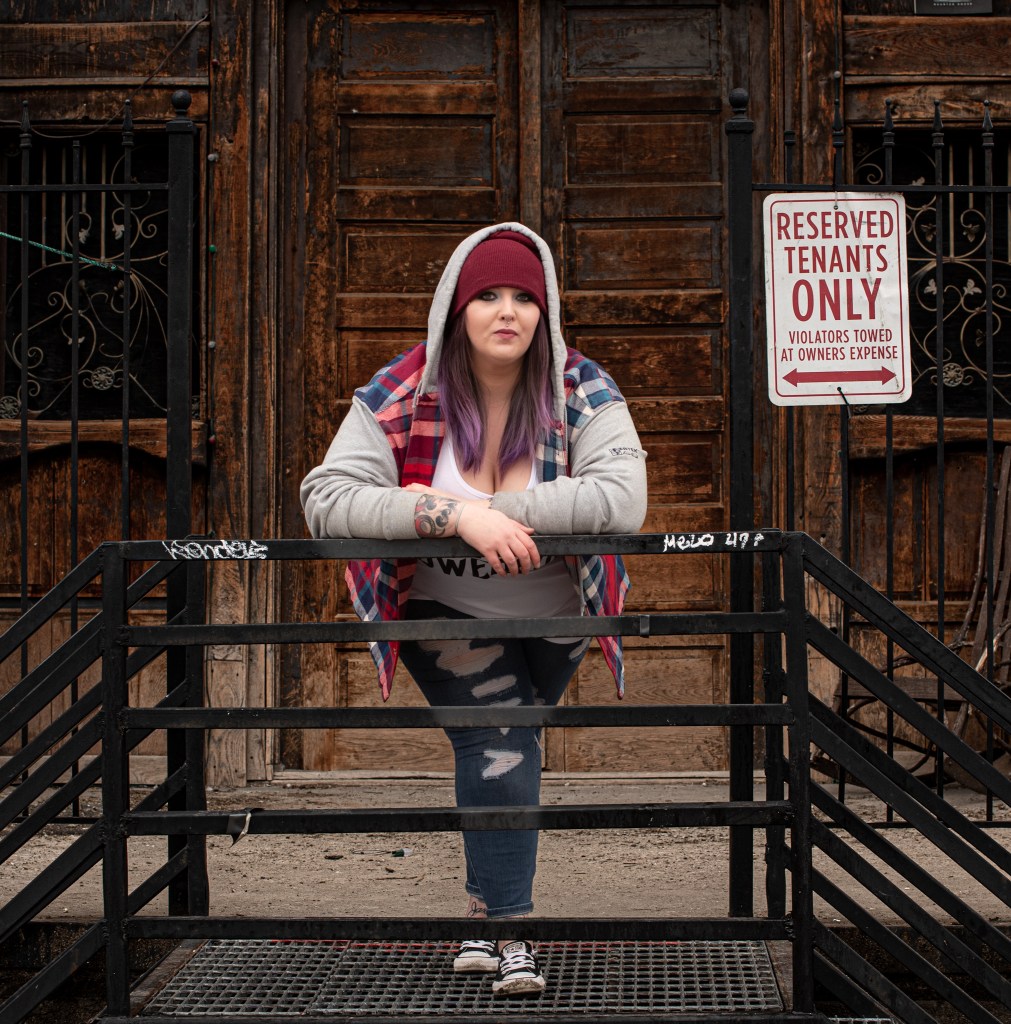
This is the original, albeit cropped a bit. Do you see the object that was removed, altering the reality of the scene? I’ll give you a hint. Look at the window on the left side of the image. Do you see the blue bungee cord? It isn’t likely that I would have been able to just go undo and move the bungee cord. This wasn’t my property nor was the property owner nearby where I could ask permission to move it. I could have waited and found the responsible party to get permission to move the cord or I could just do it in Photoshop.
Even in Photoshop it took a bit of work and was somewhat of a challenge due to the intricacy of the ironwork on the window. Aside from me working to decide the best method and a bit in remembering how the work to remove the bungee chord took very little time even with the intricate ironwork.
Want to know the funny thing about the bungee? I never noticed it until recently, as in today. My attention was always focused on Kodi. Today, I was reviewing photos in my Lightroom catalog to prepare for today’s blog post (I had no idea what I was going to write about as with most days) when I saw this photograph, and a bit of blue caught my eye. What is that, I asked myself. I zoom in and see it. It’s a bungee cord! How have I never seen that before? A few quick minutes later in Photoshop and voila! It is gone. This is why I love Photoshop and the ability to post-process my photographs!
In 2005 when I bought my first digital SLR camera I was eager to learn everything I could about the camera and photography. I bought all sorts of books, joined lots of photography forums, and a photography club. One thing I don’t remember doing however is seeking out a mentor. Someone who was more advanced than I and could guide me along my way. As a result, I often wandered aimlessly. I am not sure who I would have sought out, it seems as if there are few people willing to become a mentor.
Fast forward to today, I often wished there was a person I could seek out to keep me focused. I am actually more eager to learn today than I was 17 years ago. I read virtually everything I can find. I seek out groups on social media that I believe are frequented by photographers that are more advanced or, at least, as knowledgeable as I believe I am. I also wonder if I suffer from the Dunning-Kruger effect and think I’m better than I am. I am often disappointed in the resources I’ve found. I’m eager to learn and hone my skills but quickly get disillusioned.
The search for the ultimate mentor and photography guru continues.
During the past number of years, I have seen this cycle play out over and again. A new photographer comes along with their shiny new camera and decides after having their camera for a couple of weeks or perhaps a couple of months they want to be a professional. They’ve read all the photography forums and start off with mini-sessions. charging some ridiculously low price. They then progress into wedding photography. The photographs as okay but they are shot outside in natural sunlight on auto mode. All goes well for about a year or so when they just seem to go away. I’ve had a few of these as students at some point in their venture after they have had some sort of failure. What happened? I know some have come through tough times financially, but what about the others? Even those whom I had as students virtually disappeared from the contact information I had. Could it have been burnout? I’ve often wondered but I haven’t really found the answer.
I tried the professional photographer route once, well sort of. I tried the professional route but it was after I retired from a 32-year career with a pension so it wasn’t like I was going to starve or be homeless if it didn’t work. What I found was I hated marketing. The types of photography that were going to “pay the bills” so to speak, was fun but not really all that exciting, at least to me. Did the others experience the same thing I experienced? Maybe.
Today, I focus more on what I call photographic art. I photograph the things that interest me and occasionally others find the photographic art I produce interesting. I haven’t even listed anything for sale for a while now and that is fine. I may venture down that path again but this time, I will produce the images I want at a pace I want. If you want to be an artist make the art you want. Make the art that moves you and inspires you, that is where I’m going. Join me as artists.
This is the best time to be a photographer. In the past, we had to wait to either develop our film or to get it developed and returned to see if we had achieved what we intended when we took the photograph. Today, we don’t have to wait as long as you are using a digital camera.
In the past, we had to have a separate video camera and a film camera, today the features are combined. Our still cameras, for the most part, have a video feature and the video cameras have a still feature.
We also have the ability to get out of the dark. We don’t have to use a dark room full of chemicals when we are editing or printing our photographs. We also have advanced techniques available to us in our photo editing through modern software.
The best part of all is that if we still want to “do it the old way” with film and the darkroom we can! We have all the best options available based on how we want to take our photographs.
With all the choices we have though, I will never understand the haters. We all have choices and for the most part, no one is forcing us to do our photography one way or another. Yet in many photography forums, there are the haters and the so-called “trolls”. I used to engage them but then I realized that is what they want. I’ve changed my mindset, I’ll engage the non-haters and the non-trolls with my art. Don’t let the haters and trolls force you to change how you want to produce your photographs and art. Do it your way!
I touched on this topic a few days ago ( Has Photoshop Made It Too Easy ), but I really want to touch on this topic again. The topic is, does Photoshop or similar programs make it too easy to be creative?
I recently had a conversation with a friend about the use of editing techniques to change or add to a photograph. My friend is a very talented photographer and enjoys setting up creative sessions. We had discussed the use of Photoshop in some examples she showed me as she is learning how to utilize Photoshop more in post-processing. Later in the day she showed me some images and said she “made me feel like a lazy person not creating photographs”. I can understand that to a point.
Like my friend, I enjoy putting together props, selecting a location, the lighting, and everything else, but there are sometimes I cannot select and control the weather or environmental conditions. I may actually visualize my subjects in a storm, pouring rain, night, sunset, sunrise, or any other of a multitude of environmental conditions. I can wait for such conditions but if I’m using a model or other person will they be available on, often, a moment’s notice? Do I really want to be out during a lightning storm? We may have to wait months for foggy conditions but will it be the right season? What if I envision other elements that may or may not be something that I could find with any regularity?
I don’t believe Photoshop and the use of post-processing makes one lazy. I believe that it actually encourages more creativity. The use of programs like Photoshop creates opportunities. We can still set up the props, the lighting, the locations, and all the other elements and further enhance our vision through editing. Photoshop doesn’t make you lazy it actually creates better creativity.
I’ve discussed this topic in the past but I believe it needs to be revisited from time to time. Photography is one of the few art forms where we have a divide in mindsets over the process of creating a photograph. The divide is between post-processing and no post-processing, the anti-Photoshop snobs. (Note: I use the term Photoshop noun for Adobe Photoshop or any program that is similar.)
Why anti-Photoshop photographers are snobs
This may be a question you ask when I choose to call the anti-Photoshop photographers snobs, so I’ll explain my choice of words. Dictionary.com defines a snob as; 2. a person who believes himself or herself an expert or connoisseur in a given field and is condescending toward or disdainful of those who hold other opinions or have different tastes regarding this field:
If the discussion comes up between the pro-Photoshop photographer and the anti-Photoshop photographer we often get to the “I get it right in the camera” comment. This is just another way imply that the pro-Photoshop photograper is always just “fixing” an image because they got it wrong. To me, the photographer that says this clearly doesn’t understand photography, film or digital. These people never really worked a darkroom with dodging, burning, pushing/pulloing film, or any of the other advanced darkroom techniques.
The great master, Ansel Adams wrote a three book series, The Camera, The Negative, and The Print. Two of the three books are solely dedicated acheiving the final printed image, or 2/3s of the process of creating an image. Two thirds!
The goal isn’t to “get it right in the camera”
The anti-Photoshop crowd that argues they “get it right in the camera” don’t realize the goal isn’t to “get it right” because what is right? Who decides what is “right”?
Film and digital photography both have limits on the dynamic range they can record. Our eyes have a dynamic range of 21 stops of light. Typically, the best our cameras can do is about 15 stops of light, so I have to make a decision on what is “right” and with knowledge can split the difference if I want and bring back those stops I’ve lost.
Another issue. We see selectively. Have you ever taken a photograph and when you looked at the image later on see something you didn’t see at the time? I have. The best example I can remember was a nighttime photograph of a train station. I setup my tripod, camera, cable release, composed the composition, took the shot. When I got home and began to go through the evenings images, I realized the photograph I just knew was going to be the perfect photograph of the train station at night, I see something on one of the stations window frames. I zoom in, it’s a soda cup. I didn’t see it before when I took the shot.
I have seen very few, and I mean very few “straight out of the camera”, “I got it right in camera” images that I would say are fantastic.
The real reason for anti-post-processing
I can’t help but believe the real reason why these anti-post-processing people are sometimes so adamant about their hatred for Photoshop is it is a self-defense mechanism. They don’t know how to do it, they don’t want to admit they don’t understand something, so it is wrong and I am better because I don’t have to do it.
The bottom line
If you are like me and do post-processing using Photshop/Lightroom/or anything similar don’t worry abou the haters. They’re just envious of our ability to perform tasks they cannot perform or understand. Do your thing. Take your photographs and process away, we are the true photographic artists.
 Photographer Clay