A bold statement from a photographer who has spent over four decades behind the lens: you do not need to pack your bags and cross the country to create a masterpiece. I suspect many will disagree with this statement, insisting that true fine-art landscapes require a ticket to iconic mountains or famous canyons. I’m not sure that it is something I’m going to worry about, but I encourage all to think about what is resting right outside their door.
One of the reasons I bring this up is because I’ve noticed a trend where our local scenery is constantly overlooked. We get so caught up in planning the next grand excursion that we ignore the raw, rugged beauty of the Midwest. The rolling plains, the dense woodlands, and the way weather moves across the open sky offer an endless canvas for our work.
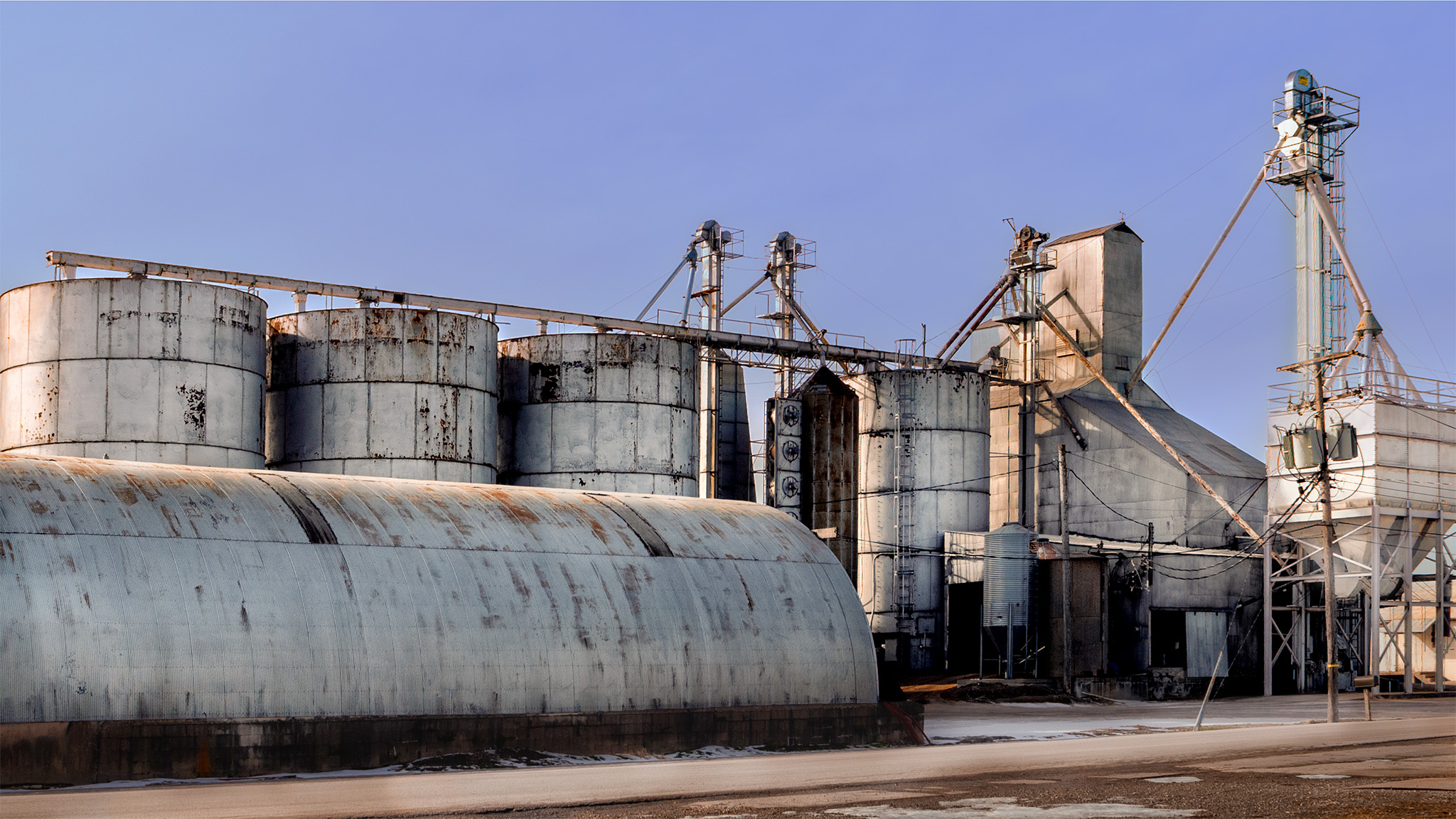
Take, for example, a subject right in our rural communities that is often dismissed as a purely industrial eyesore. I spent some time analyzing a complex of agricultural structures, and the image I’ve included here, which I’ve titled The texture of rugged.jpg, captures the scene. While many would just pass this by, the raw complexity of the massive corrugated storage silos, the sprawling Quonset-style shed, and the dizzying network of conveyors and legs that pierce the clear blue sky offer a perfect study in form and decay. I didn’t need to chase a waterfall or a red rock formation; I just had to look up.
The Weight of Weathered Steel
According to the in-camera light meter, the exposure for “The Weight of Weathered Steel “ was acceptable, but the original capture was somewhat flat, as industrial metal often is under a direct, harsh blue sky. However, when I incorporated my training and brought that file into Photoshop, utilizing tools like Blend If and my Dodge and Burn techniques, I was able to pull out the deep textures of the rust, the grime, and the structural complexity, rendering those elements as visible and tactile as they were to my eyes in that moment. I made the textures present and felt, turning a generic industrial scene into fine-art.
What is unfortunate is that there are those who believe a Midwest industrial or agricultural scene isn’t worth shooting unless it is universally recognized, or that extracting those deep tones and textures means the altered artwork is not worthy of being called a photograph. Typically, this isn’t an issue that overly concerns me. What concerns me is the lack of motivation to look deeper into the interconnected web of life, including our own human footprint and the stories in our decay, that surrounds us daily.
The philosophy of Mitakuye Oyasin reminds us that everything is related. When we fail to see the artistic potential in a massive grain storage complex or a quiet patch of prairie, the lack of motivation to understand and learn concerns me because I believe it stagnates the progression of art and photography. We don’t need a famous landmark to create authentic fine-art. Please, don’t stop exploring your own backyard, experimenting, and pushing the boundaries of your art and photography.
From the earliest days of glass plates and darkrooms to digital sensors, Photoshop, and now artificial intelligence, photography has been a continual journey of innovation, experimentation, and creative discovery. Yet with every new advancement comes a familiar chorus of voices claiming that the latest technology is somehow “ruining” photography.
But history tells a different story.
In the mid-1980s, I discovered my passion for photography long before Photoshop existed. Back then, photographers worked with film, chemicals, enlargers, and a collection of creative filters that helped shape their artistic vision. When Photoshop arrived in 1990, it was available only on Macintosh computers, and even after it became available for Windows in 1994, few hobbyists I knew were using it. The photographic world continued to evolve, and so did we.
In 2005, I embraced digital photography and began processing my images on a computer. Looking back, many of those early edits make me cringe. They were far from masterpieces. Yet every mistake taught me something valuable. Every poorly processed image became a stepping stone toward growth. Progress rarely looks perfect in the moment.
Then, in 2010, I made the leap into Photoshop despite its intimidating price tag of more than $800. It was around that time that I began hearing the criticism that digital photography was somehow destroying “real” photography. The complaints were loud, passionate, and remarkably familiar.
Today, sixteen years later, the conversation has simply shifted. Artificial intelligence has become the newest target. Some claim it is stealing photography’s soul. Others insist it is the beginning of the end for artistic expression.
I disagree.
Technology has never been the enemy of creativity. It is merely a tool. Photoshop did not diminish photography, and artificial intelligence will not diminish it either. For me, both have become valuable parts of the creative process, helping streamline technical tasks and allowing more time to focus on what truly matters: vision, expression, and storytelling.
What gives a photograph meaning has never been the software, the camera, or the process. It has always been the artist behind it.
Ironically, the rise of AI has also sparked renewed interest in film photography. That’s wonderful. Every photographer should pursue the medium that inspires them most. But let’s not confuse process with authenticity. Some argue that film brings us closer to reality, while digital and AI move us further away. The truth is that photography has never been a perfect representation of reality.
Reality is an illusion shaped by countless choices.
The lens we select, the focal length we use, the moment we press the shutter, the exposure settings we choose, the colors we emphasize, and the way an image is displayed all influence what the viewer ultimately sees. Whether working with film, digital sensors, darkroom techniques, Photoshop, or AI, every photograph is an interpretation rather than a duplication of reality.
And that is exactly what makes photography art.
So instead of spending our time debating what is ruining photography, perhaps we should focus on what has always made photography extraordinary: the ability to communicate ideas, evoke emotion, and inspire others.
The future of photography does not belong to those who resist change. It belongs to those who embrace possibility.
Create the image only you can create.
Learn the new tools. Master the old ones. Experiment fearlessly. Take risks. Make mistakes. Grow from them. Continue refining your vision and expanding your voice as an artist.
The greatest photographers have never been defined by the technology available to them. They have been defined by their willingness to see differently, think differently, and create something meaningful regardless of the tools in their hands.
Photography’s soul has never lived in a camera, a roll of film, a darkroom, a computer, or an algorithm.
Its soul lives in the imagination, curiosity, and passion of the artist.
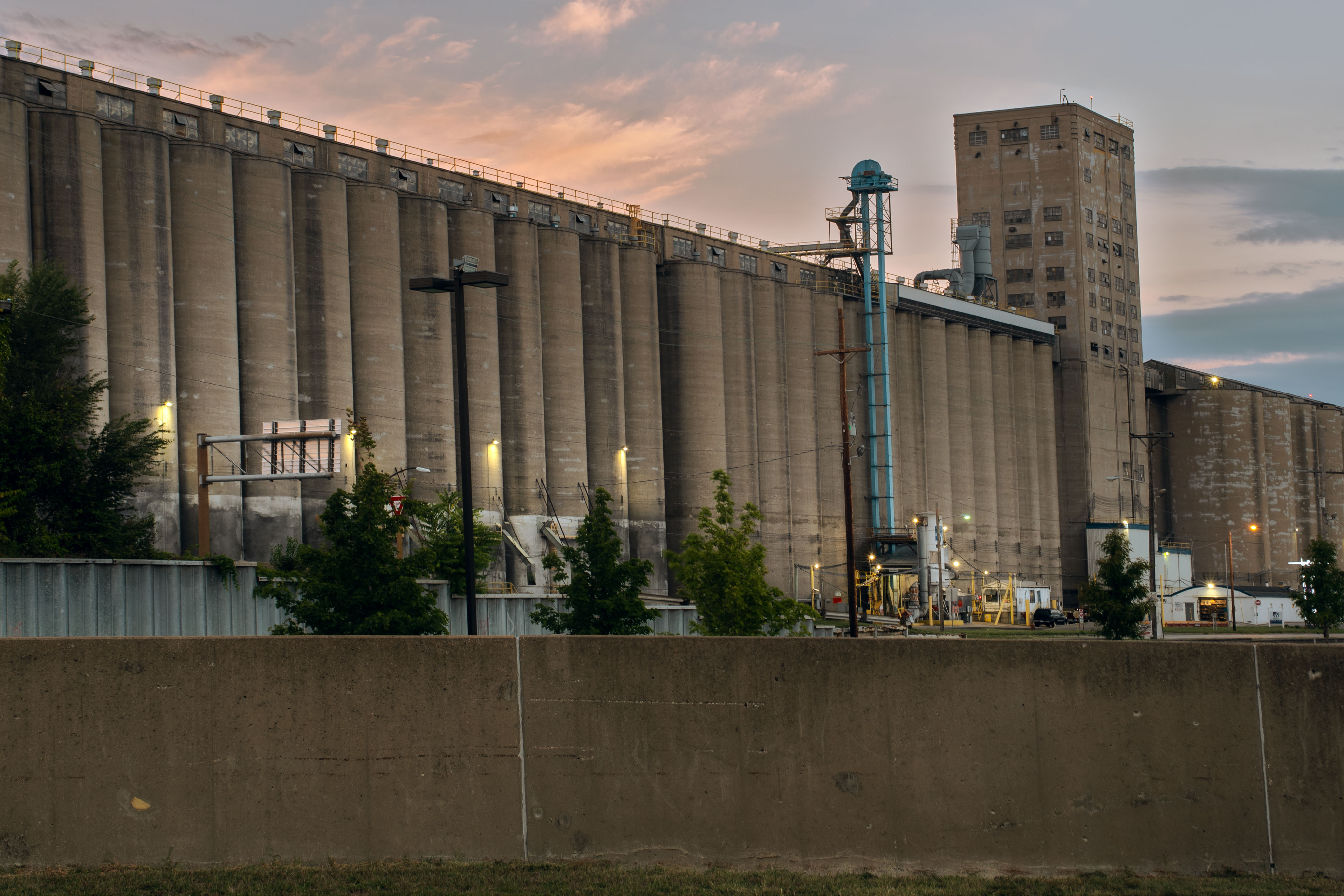
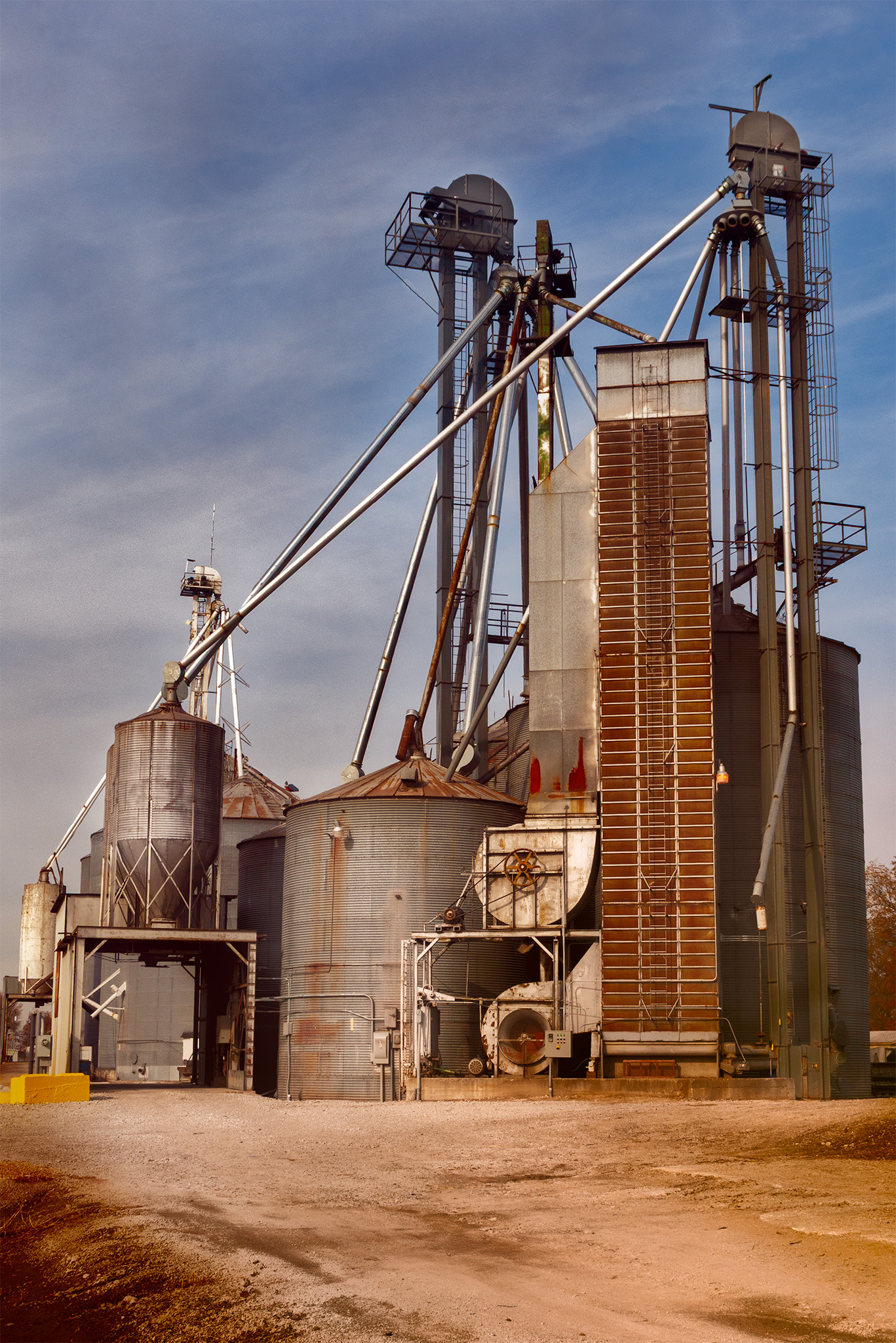
In The towers watching over the land, I explore the quiet dignity and unexpected beauty of industrial agricultural structures. Captured from a commanding low angle, these steel giants shed their purely functional purpose to become silent, imposing sentinels. Their intricate network of silos and elevators stands as a testament to human endeavor, presiding over the rural landscape and guarding the harvest. Through a warm, slightly weathered filmic perspective, I invite viewers to find reverence in these utilitarian monuments that loom over the land they serve.
For over four decades, the camera and I operated on a strict, unspoken agreement. Beginning with a 35mm film camera in 1982 and navigating the leap into the digital realm in 2005, I spent countless hours mastering the mechanics. I operated as an image analyst, relying heavily on mathematical logic to calculate the perfect exposure, the precise depth of field, and the flawless composition. I knew the rules inside and out. The camera was my objective tool, and I was its devoted technician.
But mastering the rules is only half the journey; true artistry begins when you learn how to transcend them.
My time immersed in the f64 Elite community sparked a profound shift in my paradigm. I realized that a technically perfect photograph can still be emotionally hollow. The goal was no longer to simply capture a high volume of sharp frames or perfectly execute a formula. Transitioning into fine-art landscape photography demanded something much more vulnerable: deep, deliberate intentionality.
Now, before I even release the shutter, I stop to breathe. I plan the shot with the same analytical precision as before, but I leave room for the soul of the landscape to speak. When I step onto a location, my mental notes extend far beyond light and shadow. I focus on the ambient sounds—the rustle of dry grass or the distant rhythm of water. I take in the sharp, cool scent of the morning air or the damp earth after a rain. I tune into the emotional resonance of that exact moment in time.
This sensory awareness is now woven directly into the mathematical logic of the shot. It is the vital ingredient that transforms a static digital negative into a living, breathing piece of fine art.
My ultimate goal is for you to step into that landscape with me. When you look at my work, I don’t just want you to see what I saw; I want you to feel the chill of the air, hear the quiet rhythm of the scene, and experience the profound stillness of the moment, exactly as I did.
This transition from technician to photographic artist is a continuous, evolving journey, and it’s one I want to share with you. I am currently pouring this newfound intentionality into an upcoming coffee table book that curates these very moments. Soon, I will also be launching a podcast to dive deeper into the nuances of this creative process and the mindset required to truly see the world.
I invite you to join me as we explore the landscape not just as it looks, but exactly as it feels.
There is a distinct, quiet threshold we cross in our creative lives. For years, we operate as enthusiastic collectors of moments. We learn the exposure triangle, we obsess over sharpness, and we chase the golden hour with a relentless, almost mechanical precision. We are photographers. We document what is in front of us.
But then, the paradigm shifts. You stop clicking the shutter merely to record a scene, and you start pressing it to express a feeling. You realize that the camera is no longer a tool for documentation, but an instrument for translation.
This is the journey of becoming a photographic artist.
The Foundation: Where Routine Meets Vision
The transition doesn’t happen by accident, and it rarely happens overnight. It requires creating the space for inspiration to take root. Often, the most profound artistic breakthroughs don’t come from chaotic bursts of inspiration, but from disciplined structure. When we establish dedicated routines, we actually fuel our creativity—removing the daily friction so the mind is entirely free to explore, analyze, and create.
With that mental space secured, the shift from photographer to artist ultimately comes down to mastering a triad of artistic vision: cultivating the right mindset, deepening our awareness in the field, and honoring the memory of how a scene truly felt.
Shifting the Mindset: From Looking to Seeing
As a photographer, the mindset is often technical: How do I expose this correctly? As an artist, the mindset is intentional: What am I trying to say?
When you stand before a sweeping landscape, the goal is no longer to capture the vista exactly as an optical sensor dictates. You begin to project your own internal landscape onto the physical one. You stop letting the environment dictate the image and start dictating how the environment serves your vision.
Deepening Awareness: The Power of Contrast and Shadow
With this new mindset comes a heightened awareness. A photographer looks for perfect, even light. An artist looks for mood, narrative, and tension.
You begin to realize that what you choose to obscure is just as important as what you choose to illuminate. You might find yourself drawn to high-contrast lighting, intentionally letting details fall away into deep, heavy shadows to evoke mystery or emotional weight. The landscape becomes a canvas of tones and gradients, where the interplay of light and dark tells a story that a flat, “perfectly exposed” image never could.
Honoring the Memory: The Role of the Image Analyst
Perhaps the most significant realization on this journey happens long after you’ve left the field.
For the photographer, post-processing is a task used to “fix” an image. For the artist, the digital darkroom is where the image is truly born. You step into the role of an image analyst, dissecting the raw file not for its factual accuracy, but for its emotional potential.
The goal is no longer to replicate the scene as it objectively existed, but to honor the memory of how it felt to stand there. Dodging, burning, and sculpting the light become deliberate, painterly strokes. You manipulate the contrast and guide the viewer’s eye, ensuring that the final, fine-art piece resonates with the exact atmosphere you envisioned when you first composed the shot.
The Journey Continues
Realizing you are a photographic artist is incredibly liberating, but it is also daunting. It strips away the safety net of technical perfection. An image can no longer be judged simply on whether it is sharp or well-lit; it must be judged on whether it makes the viewer feel.
It is a lifelong pursuit of aligning what you see with who you are. And once you cross that threshold, you can never look through a viewfinder the same way again.
What was the specific “turning point” image or experience that first made you realize your own work was shifting from documentation to fine art?
There is a distinct, almost magical milestone in every photographer’s journey. It happens when the mechanics of the camera—the holy trinity of aperture, shutter speed, and ISO—finally become second nature. You no longer have to think about how to expose an image properly; your hands just know what to do.
But once you conquer the technical mountain, a new, far more daunting peak reveals itself. You realize that capturing a technically perfect image isn’t the same as creating a meaningful one. This is the chasm between being a photographer and becoming a photographic artist.
Here is how to stop simply taking pictures and start making art.
The Trap of Technical Perfection
We live in a golden age of camera technology. Modern sensors are incredible, autofocus is practically telepathic, and lenses are sharper than ever. It is easier than ever to take a “good” photo. But a sharp, well-exposed photo of a boring subject is still a boring photo.
Being a photographer means you understand the light and the machine. Being an artist means you understand yourself. An artist doesn’t just document what is in front of the lens; they project what is inside their mind onto the sensor. Technical perfection is a tool, not the final destination.
From “Taking” to “Making”
Ansel Adams famously said, “You don’t take a photograph, you make it.” This subtle shift in vocabulary represents a massive shift in mindset.
• The Photographer arrives at a beautiful landscape, points the camera, and records what is there.
• The Artist arrives, studies the light, considers the mood they want to convey, decides what to leave out of the frame, and waits for the exact moment the elements align with their internal vision.
Making a photograph requires intentionality. Before you press the shutter, ask yourself: Why am I taking this? What do I want the viewer to feel? If you don’t have an answer, put the camera down and keep looking.
Developing Your Visual Voice
Your visual voice is the thread that ties all your work together. It’s what makes someone look at an uncredited image and say, “I know who shot that.” Finding this voice doesn’t happen overnight, but you can actively cultivate it:
• Consume art beyond photography: Study paintings, watch classic cinema, read poetry, and listen to music. Notice how other mediums handle composition, pacing, and emotion.
• Curate ruthlessly: We all take bad photos. The difference is that artists only show their best ones. Curating your work forces you to identify what you actually like about your own photography.
• Embrace limitations: Shoot with one focal length for a month. Limit yourself to black and white. Constraints breed creativity by forcing you to see the world differently, rather than relying on the crutch of endless options.
Emotion Over Rules
The Rule of Thirds, leading lines, and the golden ratio are excellent training wheels. But once you know the rules, you have to know when to break them to serve the narrative.
Sometimes, a blurry, grainy, awkwardly cropped photo captures the raw, kinetic energy of a moment far better than a pristine, sharply focused one. An artist prioritizes the emotional truth of the image over the rigid rules of composition. If the image makes the viewer feel something, it is successful.
The Journey Inward
Ultimately, the transition from photographer to photographic artist isn’t about buying a better camera or mastering a new editing technique in Lightroom. It is a journey inward. It requires vulnerability. It requires you to have a perspective on the world and the courage to share it.
Your camera is just a box that lets in light. The art doesn’t come from the box; it comes from the person standing behind it. Stop worrying about capturing the world exactly as it is, and start showing us the world exactly as you see it.
There was a time when photographic excellence was inseparable from patience.
For much of the 20th century, masters of the craft built their reputations not only behind the camera but in the darkroom, an environment that demanded discipline, precision, and a willingness to engage deeply with the medium. Each print was not merely produced; it was constructed. Exposure, contrast, dodging, burning, every decision was deliberate. The process itself became an extension of the artist’s vision.
This approach required more than technical proficiency. It demanded endurance, restraint, and an almost obsessive commitment to refinement. The final image was the culmination of hours, sometimes days, of iterative work. Excellence was not assumed; it was earned through repetition and critical evaluation.
From Craft to Convenience
Fast forward to today, and the landscape has shifted dramatically.
Digital technology has democratized photography in extraordinary ways. Powerful editing tools are widely accessible, workflows are streamlined, and the barriers to entry are lower than ever. These are, by most measures, positive developments. More people can create, experiment, and share their work with a global audience.
However, alongside these advancements, a noticeable shift in mindset has emerged.
Many contemporary photographers now prioritize efficiency over depth. Editing is often approached as a quick step rather than a critical phase of artistic development. One-click presets, automated enhancements, and AI-assisted tools have become standard practice. While these tools are undeniably useful, they can also foster a reliance on convenience at the expense of intentionality.
The result is a growing tension between speed and craft.
The Illusion of Effortless Excellence
There’s a subtle but important misconception at play: the idea that high-level results should come quickly.
When photographers limit their editing time to just a few minutes or rely entirely on automated solutions, they may achieve technically acceptable images. But fine-art photography has never been about “acceptable.” It’s about nuance, interpretation, and emotional resonance.
The darkroom era made one thing clear: excellence is rarely efficient.
Today’s tools can accelerate workflows, but they cannot replace the need for critical thinking. They cannot substitute for the iterative process of refining an image until it aligns with the artist’s intent. When that process is skipped or minimized, the final work often lacks depth, not because of a lack of talent, but because of a lack of engagement. Let me say that again for the people in the back: When that process is skipped or minimized, the final work often lacks depth, not because of a lack of talent, but because of a lack of engagement.
Reclaiming the Process
This isn’t an argument against modern technology. In fact, digital tools offer unprecedented control and creative flexibility. The issue is not the tools themselves, but how they are used.
Photographers seeking to elevate their work might consider revisiting some of the principles that defined earlier generations:
Intentional editing: Approach post-processing as a creative act, not a checkbox.
Time investment: Allow images to evolve through multiple passes rather than settling for quick results.
Critical evaluation: Develop the habit of analyzing what works—and what doesn’t—at a granular level.
Restraint: Avoid over-reliance on presets; instead, build adjustments from the ground up when possible.
These practices don’t require abandoning efficiency. They require rebalancing priorities.
Excellence Still Demands Commitment
The tools have changed. The pace has changed. But the underlying principle remains constant:
Photographic excellence is the product of deliberate effort.
The darkroom may no longer be a physical space for most photographers, but its philosophy still holds relevance. The willingness to slow down, to engage deeply with an image, and to refine it beyond the obvious, that is where meaningful work emerges.
In a culture that increasingly values speed, choosing to invest time and care into your process becomes a differentiator. It signals not just technical ability, but artistic intent.
And ultimately, that’s what separates a photograph from a finished piece of art.
Old photographic files are emotional archaeology. They remind me how I once saw the world, and how my seeing has changed.
I open these folders the way one brushes dust from a buried wall—slowly, half-expecting something to collapse, half-hoping it won’t. Each image is a shard. Each filename a coordinate. Together they form a landscape I once walked through without knowing I was leaving tracks.
Digital photographs pretend to be light, but they are heavy with looking. The moment they open, time bends inward. A window reappears. A street exhales. Someone I knew stands exactly where they once stood, suspended in the careless confidence of being unremembered. These images do not move, yet they advance toward me.
In the earliest files, everything is crowded. The frame tries to hold too much sky, too many faces, too much proof. I wanted the world intact, uncut, unwilling to let anything fall outside the edges. I photographed as if loss were immediate, as if memory were already failing. The camera was my insurance policy against disappearance.
What I see now is hunger. Not for beauty, but for certainty. I didn’t yet trust experience to stay with me unless I pinned it down with pixels. I needed evidence that I had been there, that the moment had weight, that it could be returned to later and still answer my name.
As the years scroll forward, the images breathe. Space appears. Silence. The subject drifts to the margins. A shadow on a wall begins to matter more than the wall itself. I stop trying to gather the world and start listening to it. The photographs no longer ask to be believed; they ask to be felt.
This is where the archaeology turns inward. The record is no longer of places, but of attention. What I framed tells me what I was ready to notice. What I left out tells me what I could not yet see. Certain colors repeat like a private language. Certain distances hold, again and again, as if I were measuring how close I dared to be.
There are years filled with people, and years emptied of them. Years that lean toward motion, and others that kneel before stillness. At the time, none of this felt intentional. Now it reads like weather—patterns moving through me, shaping what the lens could hold.
Some photographs remember more than I do. Others remember things I was sure were essential, but now barely recognize. The archive is honest in a way memory is not. It does not flatter. It does not edit for narrative. It simply keeps what I gave it.
And yet, I feel tenderness toward every flawed frame. The awkward compositions. The overexposed skies. The moments that try too hard. They are sincere attempts to understand. You can’t fake attention, even when you don’t yet know what you’re paying it for.
These files are not proof of improvement. They are proof of continuity. Each image is a layer, not a correction. Each way of seeing made the next one possible. Nothing here is wasted.
Someday, the photographs I take now will become artifacts too. I will open them and wonder what I was reaching for, what I feared might vanish, what I thought mattered most. That is the quiet promise hidden in every image—not that it will preserve the past, but that it will teach the future how to look back gently.
Rediscovering the Ordinary: How Photography Turns the Mundane into Art
Introduction
Art has always been about seeing the world differently. While many rush past the everyday, artists pause, observe, and rediscover objects that most overlook: a bowl of fruit on a countertop, a forgotten keychain, a cracked tile in the kitchen, or a worn-out doorway. These seemingly trivial items become the raw material for creative expression, especially in photography, where the lens transforms the ordinary into something extraordinary.
The Artist’s Eye: Noticing What Others Miss
Artists possess a unique ability to notice the unnoticed. Where others see clutter or routine, artists see potential. A piece of fruit, for example, isn’t just a snack—it’s a study in color, texture, and light. A keychain isn’t merely a tool for organization; it’s a symbol of journeys, memories, and identity. Even a cracked tile, often dismissed as a flaw, can become a metaphor for imperfection and resilience.
This heightened awareness is not accidental. It’s cultivated through curiosity, patience, and a willingness to look beyond surface appearances. Artists train themselves to ask: What stories hide in plain sight? What beauty lies in the overlooked?
Photography: Elevating the Mundane
Photography is uniquely suited to this rediscovery. The camera’s frame isolates objects from their context, inviting viewers to see them anew. Through careful composition, lighting, and focus, photographers elevate the mundane—fruit, keychains, tiles—into subjects worthy of contemplation.
Consider the work of still life photographers. Their images of fruit on a countertop are not just records of groceries; they are meditations on abundance, decay, and the passage of time. A close-up of a keychain can evoke nostalgia, hinting at the places it’s been and the hands that have held it. The cracked tile, captured in detail, becomes a testament to the history of a home, the passage of feet, and the inevitability of change. A worn-out doorway causes one to wonder about the things or people who have passed through on their journeys.
Why the Mundane Matters
By focusing on the ordinary, artists and photographers remind us that beauty is everywhere. The mundane is not boring—it’s the foundation of daily life, rich with meaning and possibility. When we learn to see as artists do, we discover that every object, no matter how humble, has a story to tell.
This approach also democratizes art. You don’t need exotic locations or expensive materials to create something meaningful. Inspiration is as close as your kitchen counter or your pocket. The challenge—and the joy—is to notice, appreciate, and elevate what’s already around you.
Painters mix colors; photographers sculpt with light. I’ve learned that a scene isn’t interesting until the light touches it with purpose—soft at dawn, directional in winter, violent at noon. Learning Light is the gateway to artistic photography.
For a long time, I thought subjects carried the weight of a photograph. A dramatic landscape, an expressive face, an unusual moment—surely those were enough. But over time, I began to notice that the same subject could feel flat or profound depending entirely on how light arrived. The difference wasn’t the scene. It was the illumination.
Light gives form to emotion. Soft morning light doesn’t just reveal shapes; it forgives them. It smooths edges, lowers contrast, and invites contemplation. At dawn, the world feels like it’s speaking quietly, and photographs made then tend to whisper rather than shout. Shadows stretch gently, highlights are kind, and everything feels possible but unresolved.
Winter light is more disciplined. Lower in the sky, it arrives with intention, carving hard lines and clear separations. It’s honest, sometimes unforgiving, but incredibly descriptive. Faces gain character. Buildings gain weight. In winter, light behaves like a sculptor who knows exactly what to remove to reveal the form beneath.
Then there’s midday light—the one photographers are taught to avoid. Harsh, vertical, uncompromising. But even violent light has its uses. It flattens subtlety and replaces it with confrontation. Colors clash. Shadows become graphic. When used deliberately, noon light doesn’t tell gentle stories; it tells true ones. It demands confidence and clarity in composition because there’s nowhere to hide.
Learning light isn’t about memorizing rules. It’s about recognition. Noticing how it changes across seasons, hours, and spaces. Seeing how it interacts with surfaces, how it wraps, bounces, absorbs, or disappears entirely. It’s understanding that light is never neutral—it always carries mood.
The camera records whatever light you give it. Artistic photography begins when you choose which light to work with, and when to step back and wait for it to arrive. Once you understand that, you stop chasing subjects and start collaborating with illumination.
Because in the end, photography isn’t about capturing things. It’s about shaping light into meaning.
Photography does not start with the sound of the shutter—it begins much earlier, in the quiet attentiveness of the eyes. This process is subtle and intuitive, as the eyes become attuned to the play of light, the contours of shapes, the patterns of rhythm, and the layers of meaning in the world around us. Long before a picture is made, there is a fleeting instant when something ordinary suddenly stands out, beckoning for attention and recognition.
This critical moment is often easy to overlook. It can pass unnoticed as a single breath. Our lives are filled with distractions and constant movement, often too rapid for the world’s subtle harmonies to reveal themselves. However, when I intentionally slow down—truly slow down—I discover just how generous the world can be. Light, when given time, tells its own compelling stories. A simple gesture from a stranger becomes a narrative in itself. A puddle can unexpectedly reflect a sky. In these moments, what once seemed mundane arranges itself into a compelling frame, with or without my conscious effort.
For me, this act of looking without expectation marks the true beginning of photography. It is about seeing without immediately reaching for the camera, allowing myself to feel the scene before attempting to capture it.
The Role of Attention
In conversations about photography, attention is often overlooked. Discussions tend to focus on technical aspects—lenses, sensors, megapixels, film stocks, and dynamic range. Yet, attention is what truly shapes an image, long before any of these tools come into play. It governs what is included in the frame and what is left out. It determines our patience and tells us when to lift the camera or when to wait just a little longer.
Attention is also informed by memory. Each time I recognize a particular scene—a certain quality of light or a familiar angle—I am not just reacting to the present moment. I am engaging with every photograph I have ever admired, every painting that captivated me, and every street I have explored with my camera ready. Vision in photography is cumulative, built through repetition and experience.
No two photographers standing side by side will ever create the same image. The camera itself is indifferent to meaning; it is only concerned with exposure. Meaning arises from what each photographer chooses to notice and value.
Cameras Preserve; They Don’t Create
There is a common misconception that cameras are responsible for making images. In reality, cameras do not possess curiosity or discernment. They cannot decide what is important. Instead, cameras serve as vessels, recording only what we have already learned to see. They are technical, reliable, and precise, but entirely dependent on the quality of attention we bring to them.
This is why a novice photographer, even with the best equipment available, may still feel unsatisfied with the results. The expectation that a camera can supply vision is misguided. No lens can teach someone what to care about, and no autofocus can substitute for intuition. Technology may enhance what exists, but it cannot generate vision on its own.
On the other hand, some of my most cherished photographs were taken with simple or outdated cameras—gear that would not impress anyone reading a list of specifications. These cameras belonged to photographers who spent years developing their ability to see. In these cases, it was not the tool that made the image, but the act of seeing itself.
Learning to See
The process of learning to see is not glamorous, nor does it always resemble what most people think of as photography. It is about noticing how fog can blur the edges of objects, how streetlights create glowing halos at night, and how people reveal genuine emotion in the subtle spaces between facial expressions. It involves understanding how shadows define shapes, how colors evoke moods, and how symmetry and asymmetry affect the feel of an image.
Sometimes, learning to see means deliberately walking without taking photographs. Leaving the camera in the bag trains the eye to observe without the immediate reward of making a picture, making the act of seeing itself the primary experience rather than a mere prelude to shooting.
At other times, it means looking through the viewfinder without pressing the shutter, waiting patiently to understand what the scene wishes to become. Often, the difference between a good photograph and a truly great one is just a few extra seconds of attentive stillness.
Slowness as Practice
Practicing slowness is a form of respect for the world. It acknowledges that the world does not perform on demand. Light moves according to its own rules. People will not always pose at convenient moments. The weather is indifferent to our hopes for dramatic skies.
The most compelling photographs do not feel as though they were hunted down—they feel as though they were discovered and encountered.
To truly encounter a photograph, I must allow the world to arrange itself in its own time. The camera can correct exposure after the fact, but it cannot correct impatience.
The Photograph That Already Exists
With experience, I have come to believe that the best photographs already exist in the world before the shutter closes. The photographer’s task is not to force a composition onto the world, but to recognize the composition that is already present—to see the photograph as it forms, and simply choose the moment to preserve it.
When this happens, creating a photograph feels less like imposing my will and more like coming to an agreement with what is in front of me.
Looking, Seeing, Shooting
Shooting comes after seeing, and seeing comes after looking. The real craft lies in looking—not merely glancing, but engaging with curiosity, stillness, and humility. The camera is just the final stage, a brief confirmation that true seeing has taken place.
Photography is more than the act of capturing images; it is the ongoing practice of learning how to look. Over time, the world seems to offer more and more, not because it has changed, but because we have.