Sometimes the photograph begins before we know why we want to make it.
The Moment Before Understanding
Have you ever been walking somewhere, going about an ordinary day, when something catches your attention and makes you stop? You may not know exactly what it is. There may be nothing particularly remarkable about the object itself. You simply find yourself looking at it a little longer than you intended. Something about it holds your attention, and for reasons you cannot immediately explain, you begin to see possibilities where a moment earlier you saw nothing worth noticing.
I have experienced this many times with photography. I might be looking at a familiar street, an old building, a weathered sign, or something most people would pass without a second glance. Then, without any deliberate search, something makes me stop. I find myself looking more closely, noticing the relationship between shapes, the quality of the light, the texture of a surface, or the quiet presence of something that seems to belong to another time. I may not yet know what interests me about it. I only know that I am no longer walking past.
I’ve learned not to dismiss that moment simply because I cannot explain it.
Something About This Place
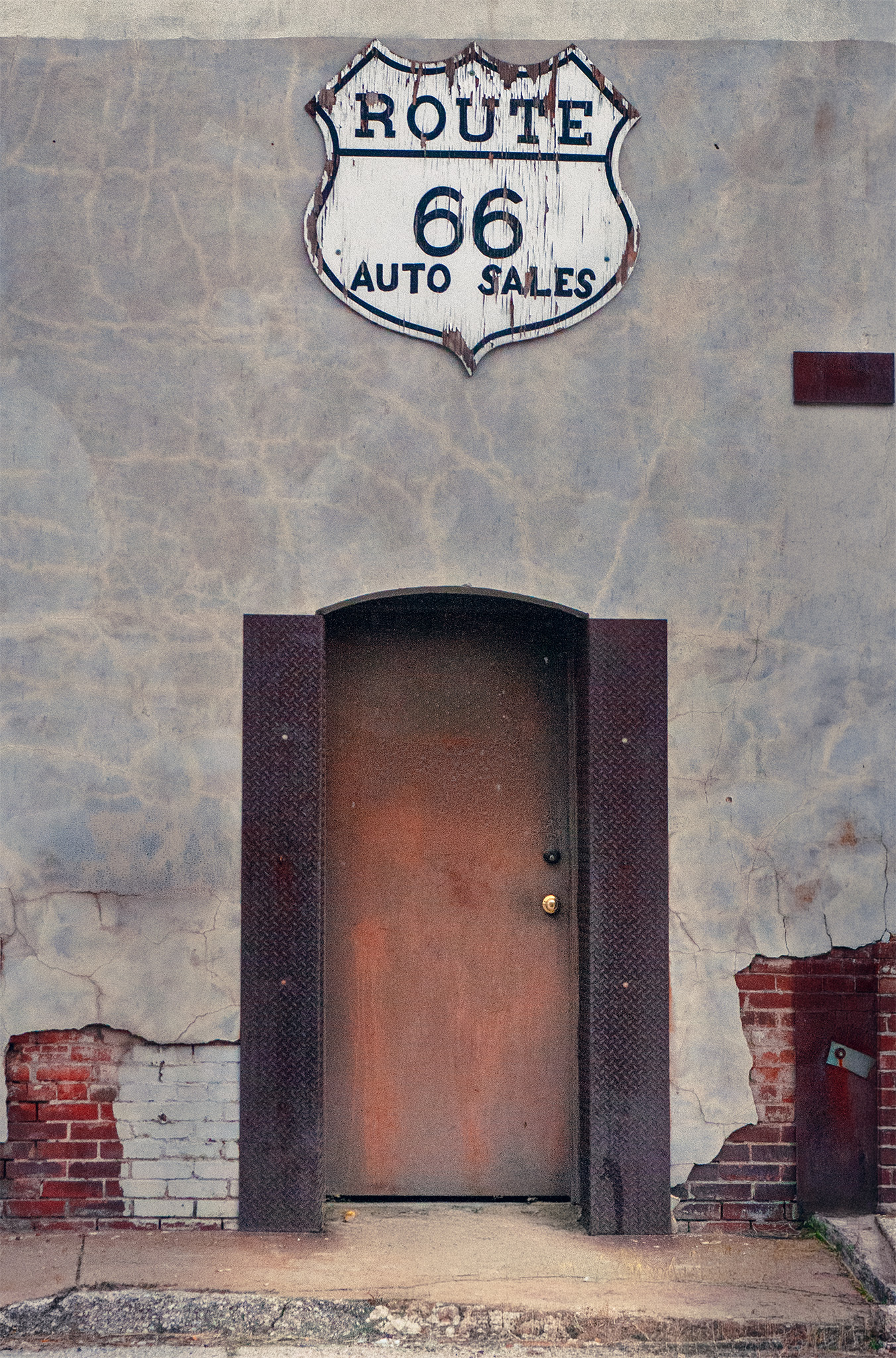
I remember photographing a weathered wall with a door beneath a Route 66 Auto Sales sign. The plaster was deteriorating, exposing the brick beneath it. The door was closed, and the sign seemed to belong to a different chapter in the life of the place. Nothing about the scene was spectacular. There was no dramatic landscape, no extraordinary light, and no obvious subject that demanded attention.
Yet something made me stop.
I could have walked past and thought nothing more about it. Instead, I began to look. The sign carried a promise of movement, commerce, and the familiar mythology of Route 66. The door offered no invitation or explanation. The worn wall revealed layers of age and change, exposing what had been hidden beneath the surface. These elements existed together, and the longer I looked, the more I became interested in their relationship.
I wasn’t simply looking at an old sign or a neglected building. I was responding to the feeling that the scene held something I wanted to explore, even though I couldn’t yet put that feeling into words.
That was enough to make the photograph.
We Don’t Always Know What We See
Photography encourages us to make decisions. We choose a subject, consider the composition, evaluate the light, and decide how to frame the scene. We learn to ask whether the elements work together and whether the resulting image communicates what we intend. These are important skills, but there is a moment that can precede all of them, a moment when our attention arrives before our understanding.
Something catches our eye, and we respond before we have constructed an explanation.
I think we sometimes underestimate the value of that response. We want to know why a subject interests us. We want to understand what a photograph will mean and whether it will become something worthwhile. We may even reject an idea because we cannot immediately explain its appeal. In doing so, we risk overlooking the very experiences that could teach us something about our developing vision.
Not every impulse will lead to a meaningful photograph. Sometimes we stop, look more closely, and discover that there is nothing there we want to pursue. That’s part of the process, too. Trusting our attention does not mean assuming every attraction is important. It means giving that attraction enough time to reveal whether something more is present.
The point is not to stop questioning what we see. It is to avoid demanding an answer before we have given ourselves time to look.
Learning to Trust the Pause
When we are beginning in photography, we often search deliberately for subjects. We look for dramatic scenery, interesting architecture, beautiful light, or something that immediately announces itself as photographically worthwhile. Over time, our attention may begin to change. We become less dependent on obvious subjects and more receptive to the quieter details and relationships that surround us.
A cracked wall, an abandoned doorway, a faded sign, or a single leaf among hundreds can hold our attention. We may not know why one particular example interests us while countless others do not. Something about the arrangement, the history we imagine, the light, or the relationship between the elements draws us closer.
I don’t believe we need to explain every attraction before responding to it. Sometimes the explanation comes later, when we review the photograph. Sometimes it emerges while we process the image. Occasionally, it takes much longer before we understand what we were responding to in the first place.
There is value in allowing that uncertainty to remain for a while. We don’t have to force every photograph to carry a grand statement. We can begin with curiosity and let our understanding develop through the act of looking.
The important thing is to recognize the moment when we are no longer merely passing through the world, but becoming attentive to it.
The Beginning of a Personal Vision
Over time, I suspect our repeated pauses begin to tell us something about ourselves. We may discover that we are drawn to evidence of age, the marks left by human activity, the tension between decay and renewal, or the quiet relationships between things that initially seem unrelated. We might find ourselves repeatedly photographing ordinary subjects that other people barely notice.
Those patterns are worth paying attention to. They can reveal the beginnings of a personal photographic voice, not because we deliberately set out to create a recognizable style, but because certain things continue to matter to us.
Our vision develops through the accumulation of these experiences. Each time we stop, look, and respond, we learn a little more about what holds our attention. Gradually, we begin to recognize connections between photographs that may have seemed unrelated when we made them. The subjects differ, but the underlying interest remains.
Perhaps we are not simply learning what to photograph. Perhaps we are learning something about how we experience the world.
That understanding cannot be forced. It grows through practice, reflection, and a willingness to remain curious about our own responses.
Allowing the Photograph to Emerge
This brings me back to the weathered wall, the closed door, and the Route 66 Auto Sales sign. I didn’t need to arrive with a complete interpretation of the scene. I only needed to recognize that something about it had caught my attention and was worth exploring.
The photograph became a way of preserving that encounter. It allowed me to return to the scene later, to consider what I had noticed, and to ask why these particular elements had held my interest. The act of photographing did not necessarily resolve those questions. It gave me something to think about.
I find that distinction important. We sometimes approach photography as though we must understand a subject before we can make a meaningful image of it. Yet the photograph itself can become part of the process through which understanding develops. We look, respond, make the image, and look again. Each stage may reveal something we did not recognize before.
There is no guarantee that every photograph will lead to a discovery. But if we insist on understanding everything before we begin, we may never give ourselves the opportunity to discover anything new.
The Practice of Seeing
The next time something catches your attention, resist the urge to decide immediately whether it deserves to be photographed. Stop for a moment. Look at what attracted you, then look beyond it. Notice the surrounding details, the relationships between the elements, and anything that becomes visible when you give the scene more time.
Ask yourself what first drew you in, but don’t insist on finding a complete answer. If your interest remains, make the photograph. Later, when you review it, consider whether you can recognize what held your attention and whether the image expresses something you hadn’t fully understood at the time.
You may discover a meaningful connection. You may find that the photograph doesn’t quite work. Either outcome can teach you something, provided you remain willing to examine the experience honestly.
The practice isn’t about following every impulse without thought. It’s about learning to recognize the difference between a passing glance and a moment of genuine curiosity, then giving that curiosity room to develop.
I’ve come to believe that artistic vision is shaped not only by the photographs we make, but also by the moments when we choose to stop and look more closely. Those moments may seem insignificant when they happen. We may not understand their importance until much later.
Sometimes, all we know is that something made us stop.
For now, that can be enough.
Featured Photograph
Title: Something Made Me Stop

Artist’s Reflection
I stopped because something about this ordinary place held my attention. The weathered wall, the closed door, and the Route 66 Auto Sales sign seemed to belong to a story I could sense but couldn’t fully explain. I didn’t need to know that story before making the photograph. I only needed to recognize that I wanted to look more closely.
Looking back at the image, I can begin to consider what drew me to it and what the scene revealed about the things I notice. Perhaps that is part of the practice: allowing a photograph to begin with curiosity and giving its meaning time to emerge.
A Question to Carry Forward
What makes you stop when nothing around you seems to demand attention?
Pay attention to those moments. They may reveal more about your photographic vision than the subjects you set out deliberately to find.
Leave a Reply